Hair Ties for Space Buns & Variations
Hair ties for space buns need to hold two separate buns in place and, if you like, add a decorative finish. Whether you want playful festival loops or subtle low buns, this guide from BabunobGem explains which kinds of ties suit each variation and how to wear them with less tugging on your hair.
Key highlights
- How elastic tension and fabric friction affect how space buns hold and how they feel on your scalp.
- Clear, step-by-step tutorials for classic high buns, half-up looks, down buns, and braids.
- A simple two-tie method that pairs a plain base elastic with an embroidered accent.
- Common tension mistakes to avoid, including pulling too tightly at the hairline.
Choosing the Right Hair Ties for Space Buns and Variations
The right hair ties for space buns balance elastic stretch with surface grip, so each bun can stay in place without a very tight pull on your scalp.
Unlike a single ponytail that gathers all hair at one central point, space buns divide your strands into two separate weight zones, so each hair tie carries its own load. If an elastic is too loose, the bun can droop toward the ear. If an elastic is too rigid or narrow, it can dig into the hair and tug on the hairline around the temples and crown.
Selecting the right fastener starts with the difference between a base tie and an accent accessory. A base tie provides the foundational grip that holds your initial pigtails close to the scalp. An accent tie, such as an embroidered button hair tie or a fabric scrunchie, goes over the coiled bun to cover the base elastic and add visual texture. Using both lets the base tie do the holding while the accent tie handles the look.
Mechanical Properties: Elasticity, Diameter, and Fabric Sheathing
Every hair tie operates under three primary physical dynamics: tensile recovery, surface friction, and contact surface area. Standard rubber bands have high friction and little surface cushioning, and a thin one can dig into hair. Seamless poly-blend elastics can offer even recovery and less snagging, which makes them practical for inner anchors. However, they lack decorative presence when worn alone. Curly and coily hair behaves differently under tension, so these hair ties for curls are worth a look.
Fabric-covered ties change this dynamic. A textured fabric such as linen adds some grip, while smooth fabrics such as silk and satin tend to have lower friction and may need an extra anchor on fine, slick hair. When choosing hair accessories for space buns, a wider fabric covering spreads the pressure over a larger area, which can reduce dents in the hair and make slipping less likely during movement. Fabric bands sit softly on fine strands, and our guide to choosing a scrunchie for thin hair goes into more detail.
Matching Hair Ties to Bun Elevation and Hair Density
The height of your buns affects how much tension your fasteners need to handle. High space buns sit atop the parietal ridge and work against gravity as your head moves, so they usually do better with a tie that has firm recovery and does not stretch out under the bouncing weight of dense coils. In contrast, low space buns, often called down buns, rest against the nape of your neck, where the curve of your neck and shoulders helps support their weight.
Hair density also changes which fasteners work for you. Fine hair easily slips through oversized, loose elastics, so smaller-diameter loops that wrap two or three times cleanly tend to work better. Thick or coarse hair usually needs wider elastics that stretch enough to wrap around a substantial bundle without snapping. Using the comparison table below, you can match your desired space bun silhouette with a suitable fastening material. If your hair has a lot of texture, our curly natural bun guide shows how to gather it gently.
| Hair Tie Type | Good For | Hold Characteristics | Hair Density |
|---|---|---|---|
| Seamless Poly-Blend Elastic | Classic High Space Buns | Firm grip, narrow profile, high rebound | Fine to thick hair |
| Embroidered Button Hair Tie | Half-Up Buns & Down Buns | Decorative accent worn over a base elastic | Depends on the base elastic |
| Wildflower Silk Scrunchie | Relaxed Textured Space Buns | Silk fabric; smooth fabrics can slip on fine hair | Depends on your hair and how loosely you wrap |
| Linen Bow Scrunchie | Low Down Buns | Linen with a bow; adds a decorative detail | Depends on your hair and how loosely you wrap |
| Spiral Plastic Coil | High-Movement Active Buns | Water-resistant, dispersed pressure rings | Thick or coarse hair |
| Wide Jersey Fabric Tie | Messy Half-Up Loops | Gentle stretch, medium hold, wide band | Fine to medium hair |
| Mini Clear Elastic | Braided Space Bun Ends | Discreet anchor for securing braid tails before wrapping | Many hair textures |
| Ribbed Cotton Elastic | Everyday Low Space Buns | Even elasticity, moderate grip, soft edges | Fine to medium hair |
| Velvet Scrunchie | Retro High Space Buns | High surface friction, plush visual volume | Thick, curly, or heavy hair |
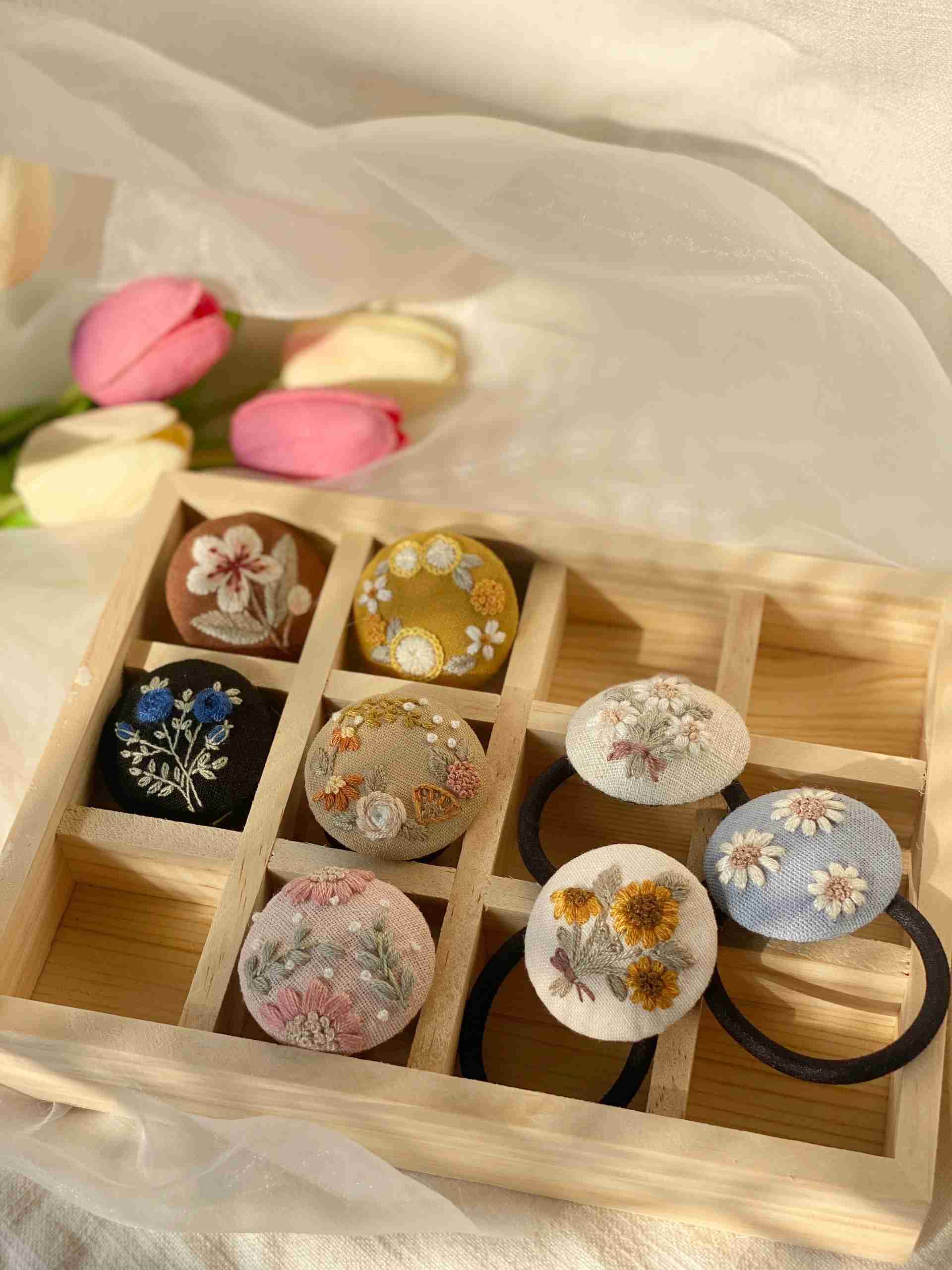
Plain elastics do the holding, but they are not much to look at. The Set Autumn Button Hair Ties are embroidered button hair ties, sold as a set, that add a handmade touch to your buns.
How to Style Space Buns Step by Step: 5 Essential Variations
To create space buns, part your hair cleanly, secure twin pigtails with seamless base elastics, and wrap each coil with a fabric hair accessory to finish the shape.
Space buns are a versatile dual-knot hairstyle. They adapt easily to casual workdays, weekend outings and seasonal gatherings. While the classic festival style sits high on the crown, variations such as half-up styles, braided coils and low down buns give you distinct looks for different outfits and hair lengths. Follow these five methods to build balanced buns step by step. Double buns have a playful retro feel, and you can explore more 90s hairstyles with scrunchies in our throwback guide.
Step 1: Prep and Part Your Hair Evenly
Every successful dual-bun hairstyle begins with a clean parting line. Use the tail of a comb to draw a straight line from the center of your forehead, over the vertex, and down to the nape of your neck. For a relaxed, modern look, you can create a loose zig-zag part for a softer line at the scalp.
Once parted, clip one side away with a hair clip while you work on the other. If your hair is freshly washed and slippery, mist the lengths lightly with water or a texturizing spray. Hair with a slight grip wraps more predictably than freshly conditioned, ultra-silky strands. Avoid applying heavy oils directly at the root, which can make base hair ties slide down.
Step 2: Build the High Classic Space Buns
Brush the first section upward toward the top crown, aligning the base of the pigtail with the high corner of your cheekbone for a flattering angle. Secure this ponytail with a slim, seamless elastic band. Repeat the process on the opposite side, checking in a mirror to confirm both pigtails sit at matching heights and distances from your ears.
Twist the lengths of one ponytail gently down to the ends. Coil the twisted strand around its base elastic in a clockwise direction, keeping the spiral snug against your head. Secure the outer bun by looping a second elastic or a botanical fabric tie around the perimeter. Repeat on the opposite side, ensuring you twist in the opposite direction for symmetrical visual balance.
Step 3: Craft Half-Up Half-Down Space Buns
Half-up space buns work well for shorter bobs, fine hair, or anyone wanting a playful look while keeping hair flowing around the shoulders. Begin by sectioning off the top half of your hair, drawing a line from the top of each ear upward toward the crown. Clip the bottom section out of the way so it remains separate.
Split the upper half down the center into two equal portions. Secure each small pigtail with a soft elastic band. Because each bun contains only half of your hair volume, wrap the coils loosely to create the illusion of fullness. Slip a small decorative tie, such as an embroidered button hair tie, over the finished mini buns to conceal the base elastics and add a decorative finish.
Step 4: Secure Low Space Buns (Down Buns)
Low space buns, commonly known as down buns, sit near the nape of the neck. This variation gives an understated, vintage-inspired silhouette that pairs naturally with linen dresses and knitwear. Divide your hair evenly down the back, gathering each half near the base of the skull behind each ear. When you want a tidier low knot at the nape, a chignon bun hairstyle follows many of the same steps.
Fasten each low pigtail with a flexible elastic. Rather than coiling tightly like high buns, twist each bundle loosely and fold it into a soft knot. Secure the knot with an elastic tie or a linen bow scrunchie. Because down buns sit lower, there is usually less gravitational pull on the roots than with high buns, so they can be wrapped more loosely. If your scalp feels sore, take the style out and try a looser wrap.
Step 5: Wrap Braided Space Buns for Added Texture
Braided space buns tend to last well because the woven strands hold layers together, which helps keep loose ends from poking out during movement. Begin by creating two pigtails at your chosen height, whether high on the crown, mid-head, or down near the nape. Secure each base firmly with a seamless poly-blend tie.
Braid each ponytail into a standard three-strand braid, securing the bottom with a mini clear elastic band. Gently tug on the outer loops of the braid to pancake the weave, creating a wider, flatter profile. Coil the flattened braid flat against the base of the pigtail and pin or wrap an accent tie around the base. The braided texture helps the bun keep its shape as you move.
Practical Styling Tips from Our Studio
In our studio, we pair a thin base elastic with an embroidered accessory on top, so the elastic does the holding and the accessory adds the detail.
Making botanical hair accessories by hand has taught us a lot about fabric and thread, and how different textiles sit on hair. Here are four practical styling methods we often share with women who love space buns.
The Two-Tier Fastening Method: Try not to rely on a single decorative tie to both hold the weight of your hair and show off its embroidered pattern. First, anchor your pigtails with a slim base elastic. Then, wrap your bun and place your embroidered button hair tie or linen scrunchie over it as the outer layer. The base elastic does the holding, so the decorative tie is not stretched to its limit. If you also love a looser look, this guide to the right hair tie for a messy bun is a handy next read.
Balancing Asymmetry Without Starting Over: If one space bun turns out larger or looser than the other, do not unwrap both sides completely. Take the looser bun, slide one finger through the center core, and gently rotate the coil an extra quarter turn. Tuck the slack under the base tie and secure the perimeter with a small accent tie to balance the silhouette quickly.
Taming Temple Flyaways Naturally: High space buns can expose fine baby hairs along the temples and nape. Rather than coating your roots in stiff styling gels that can stain embroidered fabrics, use a clean, soft-bristle toothbrush misted with plain water or a drop of light hair oil to smooth flyaways in the direction of your hair ties. For a sweeter finishing touch at each bun, you can also see our linen bow scrunchie here.
Coordinating Hair Accessories for Space Buns with Headbands: For an elevated cottagecore look, pair low down buns with a 1.2-inch hand-embroidered headband placed along your front hairline. The headband frames your face and can help keep short bangs off your forehead, while the low twin buns at the back balance the look. You can see our hand-embroidered silk scrunchie here, a soft accent to wrap around either bun.
Common Space Bun Mistakes and Gentle Fixes
Common space bun mistakes include applying excessive tension to the front hairline, using exposed metal elastics, and coiling hair in inconsistent rotational directions.
Space buns should feel enjoyable and expressive, not uncomfortable or exhausting to maintain. Paying attention to how much tension you use makes it easier to keep your scalp comfortable.
Mistake: Pulling pigtail roots too tightly against the scalp. Fastening base elastics with excessive force pulls hard on the hairline along the temples and forehead. The American Academy of Dermatology notes that hair pulled back tightly over and over can cause traction alopecia, a type of hair loss. To lower the risk, anchor your base elastics firmly but not tightly, then slide your fingertips under the roots and gently wiggle outward to release excess tension before coiling the bun. If you notice thinning, see a dermatologist.
Mistake: Using hair ties with exposed metal joins. Some inexpensive elastics have a glued or crimped metal clamp that joins the band ends. As you wrap and twist your space buns, these metal edges can snag hair and cause breakage and frayed ends. Look for seamless fabric-covered bands or smooth knit elastics with no exposed metal.
Mistake: Twisting both buns in the same directional rotation. If you twist both pigtails clockwise, your space buns can look lopsided and misaligned from the front. For balanced symmetry, twist your right bun outward (clockwise) and your left bun outward (counter-clockwise), coiling away from the central part on both sides. This creates an even, mirrored frame for your face.
Hair Ties for Space Buns FAQ
Which hair ties for space buns work well on fine hair?
Fine hair often does well with smaller-diameter, seamless elastics for the base anchor, with a fabric accent tie on top if you want a decorative finish. Smooth fabrics such as silk can slip on fine hair, so keep the base elastic in place underneath. Avoid heavy, thick bands that can slide down the hair because of their own weight.
How do you keep space buns from falling down during active days?
Use the two-tie method. Secure the base pigtail firmly with a good elastic, braid the ponytail lengths to contain layers, and wrap the braid into a coil before securing it with a second elastic. This double anchor gives the bun more support as you move.
Can I create space buns without using Bobby pins?
Yes. If you use elastic ties with good tensile recovery, you can secure the entire bun shape using bands alone. Twist the bun firmly, hold the coil flat against your scalp, and loop a stretchy fabric tie or button elastic twice over the entire bun structure.
What is the difference between classic space buns and down buns?
Classic space buns sit high on the top crown of your head, creating an energetic, elevated silhouette. Down buns sit lower, at the nape of the neck near the ears, for a softer look that usually puts less weight on your roots and is easy to wear under hats.
How do I care for hand-embroidered button hair ties after styling?
Because our button hair ties are hand-embroidered, do not put them in a washing machine. Gently spot clean any cosmetic residue or styling product by wiping lightly with a clean, damp cloth, then let the tie air dry completely flat, away from direct heat.
Finding Your Everyday Space Bun Balance
The right hair ties for space buns make it easier to enjoy expressive double knots, whatever shape you choose. At BabunobGem, we hand-embroider our hair accessories in small batches in our Ho Chi Minh City studio. Orders are usually prepared in 1–3 business days, delivery to the US is estimated at 10–14 business days with tracking, and you can return items within 30 days under our Return Policy.
New here? Get 10% off your first order
Join our list for new small-batch designs and restocks, or browse the collection now.
Note: Each piece is embroidered by hand, so stitches and colors can vary slightly from the photos. Fit and feel depend on head size, hair type and how you wear it. This guide is for general information only.