History: When Were Headbands Invented?
When were headbands invented? There is no single date or inventor. Hair bands, wreaths and circlets appear in the art of ancient Greece and Rome, and styles have changed ever since. This guide traces wreaths, the Alice band, flapper bandeaux and 1960s–80s looks, with embroidered ideas from BabunobGem.
Key highlights
- Hair wreaths and circlets appear in the art of ancient Greece and Rome, and no single inventor or date is known.
- Headbands have signaled honor, status and celebration at different times, and today they are mostly about personal style.
- Looks such as 1920s flapper headbands and the Alice band are two well-known chapters in everyday headband fashion.
- Soft fabric bands and rigid frames feel different, so choose what is comfortable for you.
The Historical Evolution: When Were Headbands Invented?
No single inventor or date is known, because people have bound and decorated their hair for as long as we have records. Hair bands, wreaths and fillets appear in the art of ancient Greece and Rome, and over the centuries they moved from ceremonial adornments to everyday fashion accessories.
So, when were headbands invented? Historians cannot point to a first headband, because wrapping, tying and decorating the hair is one of the oldest forms of personal styling. Cloth, cord and plant materials often do not survive, so much of what we know comes from art, written descriptions and surviving metalwork. Rather than a single invention, the story is one of wreaths, ribbons, circlets and bands that changed with every era and culture. That is why this guide looks at broad themes rather than exact dates.
In many cultures, a wreath or band worn around the head could carry social or ceremonial meaning, such as honor, celebration or rank. So, rather than only holding stray strands back, headwear often said something about the person wearing it, and that meaning changed from one era to the next. Their purposes changed over time, and our article on what are headbands for covers everyday uses today.
Ancient Beginnings: Plant Wreaths and Metallic Diadems
In ancient Greece, wreaths and fabric bands, often called fillets, are commonly linked to ceremonies and athletic competitions. Winners of contests are often described as being crowned with wreaths of olive, laurel or other leaves, and leafy crowns are still a familiar symbol of honor today.
Beyond athletics, art from ancient Greece and Rome often shows women with ribbons, cords and bands holding up elaborate hairstyles. Ornate metal headpieces are also known from other ancient cultures, including Mesopotamia, where gold circlets are often linked to people of high status. In ancient Rome, wreaths and metal circlets are commonly associated with celebrations, ceremonies and displays of rank.
Medieval and Renaissance Eras: Veils, Fillets, and Structured Hoods
In medieval Europe, married women often covered their hair in public, and simple bands or fillets were commonly worn along with veils and other head coverings. Fashions varied widely by place, period and social class.
In the Renaissance, headbands, circlets and decorative hoods often appear in portraits of wealthy people, frequently made from rich fabrics and trimmed with jewels or embroidery. In this era, they are commonly linked to courtly fashion and status, though styles differed from place to place.
Early Twentieth Century: Flapper Bandeaux
Through the early twentieth century, hair accessories kept changing alongside clothing and hairstyles, and the 1920s brought a very recognizable headband look.
The 1920s are commonly linked to flapper fashion, when many women wore shorter, bobbed hair and decorated bands across the forehead, often called bandeaux. These bands were often trimmed with beads, feathers or embroidery, and the look is still widely associated with the decade today. If the flapper look appeals to you, our retro headbands guide shows more vintage-inspired ideas.
Mid-to-Late Twentieth Century: The Alice Band, Bohemians, and Athletic Sweatbands
The horseshoe-shaped band is often called an “Alice band”, and the name is commonly linked to the illustrations of Alice in the Alice in Wonderland stories, where the character wears a band that holds back her long hair. Over the twentieth century, the shape became a familiar everyday accessory in many places.
From the 1960s onward, boho and counterculture looks are commonly linked to soft textile headbands, woven cords and flower-inspired styles worn across long, loose hair. In the 1970s and 1980s, sporty terrycloth sweatbands also became a familiar look, often associated with sports such as tennis. Natural fibers, earthy textures and botanical embroidery are still often used in cottage-inspired styling. The table below is a simplified overview, since styles varied widely by place, period and wearer.
| Historical Era | Dominant Materials | Primary Function | Symbolic Meaning |
|---|---|---|---|
| Ancient Greece | Olive twigs, laurel leaves, raw wool | Athletic awards and religious processions | Victory, civic honor, and divine favor |
| Ancient Mesopotamia | Gold leaf, lapis lazuli, carnelian | Royal adornment and ceremonial rites | Sacred power and sovereign status |
| Ancient Rome | Silver, gold leaf, embroidered fabric | Triumphal banquets and status display | Military distinction and patrician rank |
| Medieval Europe | Linen ribbons, stiffened wool, wire | Securing veils and framing face shape | Modesty, piety, and domestic order |
| Renaissance | Silk velvet, seed pearls, gold thread | Architectural hair styling for nobility | Courtly elegance and artistic refinement |
| Early 1900s | Lace, grosgrain ribbon, rosettes | Decorating and trimming hairstyles | Fashion and personal style |
| 1920s Flapper Era | Beaded satin, feathers, floral lamé | Accenting cropped bobs for evening wear | Youth independence and modern rebellion |
| Mid-Twentieth Century | Plastic and fabric-covered bands | Everyday school and domestic grooming | Youthful simplicity and practical charm |
| 1960s–1970s Boho Era | Woven cotton, linen, braided yarn | Holding loose hair during festivals | Harmony with nature and free expression |
| Late Twentieth Century | Knitted terrycloth, elasticized yarn | Absorbing sweat during athletic sports | Active energy, focus, and performance |
Wildflowers Embroidered Headband
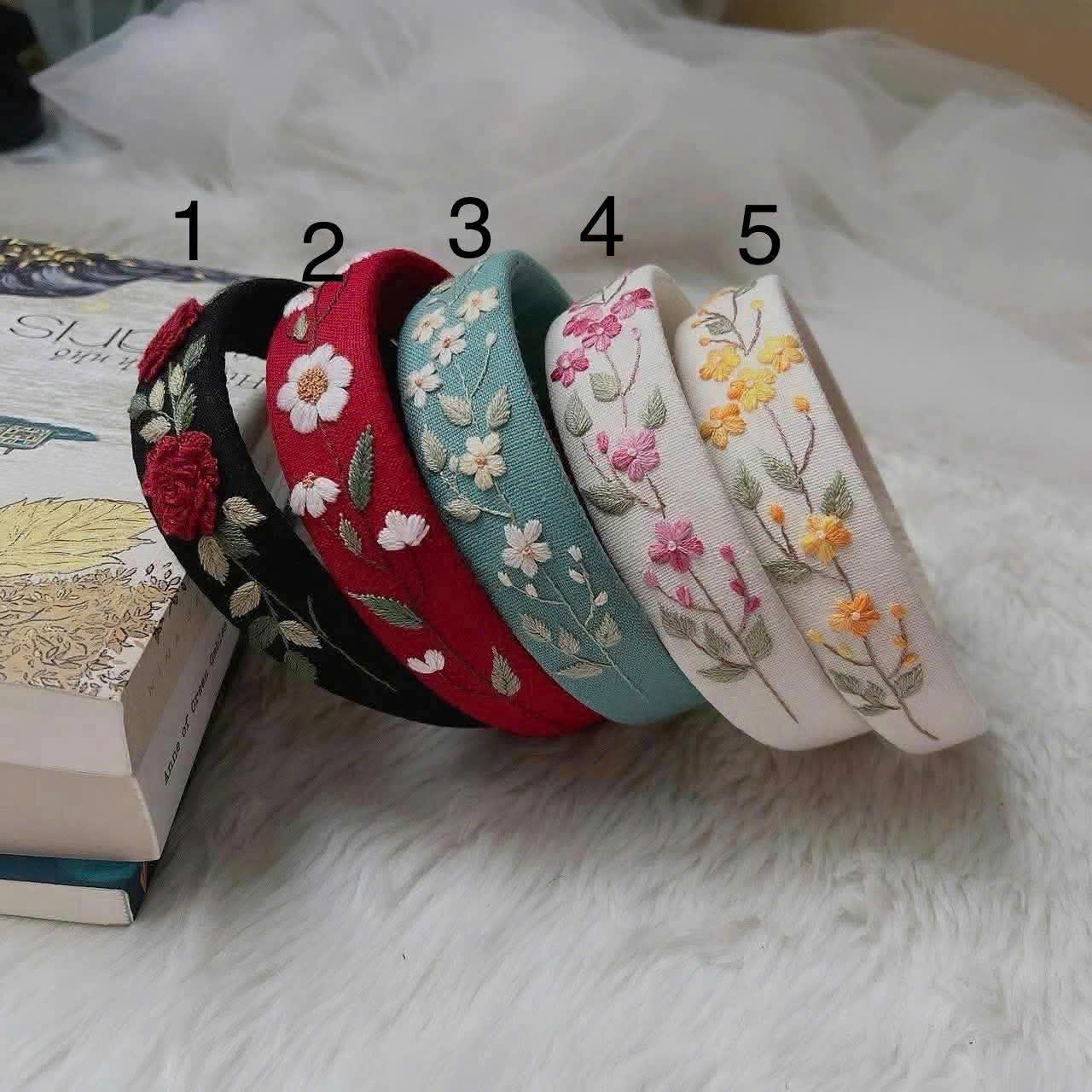
This headband is hand-embroidered with wildflowers on natural linen, on a soft, stretchy band that is 1.2 in (3 cm) wide.
How to Select and Style History-Inspired Headbands
To choose and style a history-inspired headband, evaluate the band’s underlying flexibility and fabric texture, match the width to your facial proportions, and position the accessory just behind your hairline, adjusting until it feels comfortable to you.
Modern headband designs take cues from many chapters of their long history. Choosing a piece often comes down to balancing structure with comfort and personal wardrobe preferences. When selecting an accessory inspired by historical silhouettes, a simple four-step process can help you find one that suits your routine. Today there are many shapes and widths, which our guide to types of headbands walks through.
Step 1: Evaluate Band Construction and Core Materials
The internal core of a headband determines how it interacts with your scalp and hair strands throughout the day. Hard plastic frames, a style often linked to the Alice band, can hold thick hair and bangs firmly in place, though some people find the tips press behind the ears after several hours of wear. Metal diadems and wire-based crowns offer antique glamour for special occasions, but they can feel heavy and less flexible for casual daily wear.
By contrast, soft textile bands have a different feel. At BabunobGem, our headbands are hand-embroidered on natural linen, 1.2 in (3 cm) wide, on a soft, stretchy band. Each piece is slightly different. You can see our black headband here, a hand-embroidered floral piece on a soft, stretchy band.
Step 2: Choose Band Width and Floral Aesthetic
Band width significantly influences both the visual impact and the historical mood of your outfit. Narrow bands can recall the delicate fillets and laurel wreaths of ancient Greece, giving an understated framing line for minimalist styles. Wider bands are often associated with 1920s bandeaux and 1970s bohemian wraps, creating a focal point across the crown. Try a few widths in front of a mirror to see what suits your hairstyle and outfit.
Floral embellishments can echo the plant wreaths of ancient times. Hand-embroidered botanical designs, such as roses, daisies, lavender, sunflowers, lilies, wildflowers, or bees and berries, add stitch texture and handmade character. Band colors such as natural and cream, black, green, yellow, pastel, and rust can pair nicely with vintage cardigans, linen dresses, and denim. You can browse our floral headband collection to see modern pieces inspired by these plant wreaths.
Step 3: Match Headband Style with Your Daily Hairstyle
Headbands can be styled with many different haircuts. For short pixie cuts and chin-length bobs reminiscent of the 1920s, a fabric headband can add soft textural contrast. Simply slide the band straight down over the crown, allowing your bangs or side fringe to sit naturally in front.
If you wear your hair long, try pairing an embroidered headband with loose cottagecore waves, a low twisted chignon, or a side-swept Dutch braid. Rather than scraping all hair backward into a rigid ponytail, gently pull a few soft tendrils loose around the temples and ears before placing the accessory. This relaxed approach nods to romantic and bohemian styling while framing your face softly. If you are unsure how a band will sit, try it on and move your head from side to side before you head out.
Step 4: Position the Band for Balanced Weight and Grip
Placement can change how a headband feels and whether it shifts. Avoid pulling a headband straight down against the crown like a clamp. Instead, try positioning the front edge a little behind your natural hairline, so the fabric rests with the natural growth direction of your hair. For step-by-step placement ideas, see how to wear a headband in our separate guide.
Gently angle the lower tips backward rather than pressing them directly behind your ear lobes. This subtle tilt can help spread the band’s tension more evenly, and you can adjust it as you move through everyday tasks at home, school, or the office.
Practical Headband Tips from Our Embroidery Studio
Practical care habits and mindful styling techniques can help you look after hand-embroidered linen accessories and keep your styling simple from morning until evening.
Working with natural linen and embroidery floss gives us a close look at how hand-embroidered accessories are handled. Here are four practical tips for caring for and styling textile accessories.
Angle the band ends behind your ears. When slipping on a fabric headband, check that the tips rest behind your ears rather than pressing down on them. Tilting the band slightly backward may help it feel more balanced during long workdays. If you feel soreness, take the headband off.
Spot clean and air dry. Hand-embroidered accessories should not go into a washing machine or be soaked. When a smudge occurs, gently dab the area with a soft, damp cloth, then let the piece air dry flat on a towel, away from direct heat. Once you own a few, our tips on how to store headbands can help keep them tidy.
Pair fabric accessories with natural-fiber clothing. Textured botanical headbands can look lovely with woven materials like linen dresses, cotton blouses, and chunky knit cardigans. Mixing handmade hair pieces with tactile wardrobe fabrics can create a cohesive, vintage-inspired cottagecore look.
Layer smaller hair accents for versatile styling. If you want to keep wispy flyaways contained without over-tightening your headband, try pairing your band with matching embroidered snap clips or an artisanal linen scrunchie. Layering lets a few small pieces share the work instead of relying on one tight band. Try one accent at a time first, then add another only if you like the look.
Common Headband Mistakes and How to Avoid Them
Scalp discomfort and frayed embroidery can often be traced to rigid frames with sharp inner teeth, hair pulled too tightly, or handmade textiles put through a washing machine.
Even though headbands have adorned human heads for millennia, modern wearers frequently encounter frustrating issues with fit, comfort, and durability. Recognizing these common errors helps you protect both your hair strands and your favorite artisanal accessories.
Mistake: Wearing rigid plastic frames with sharp inner grip teeth. Some plastic headbands have stiff teeth along the inner edge to grip the hair, and some wearers find them uncomfortable after a few hours. The fix: If a band feels sore, take it off and try a softer, fabric-covered style instead. If the discomfort continues, see a doctor.
Mistake: Pulling hair taut beneath the band into high-tension hairstyles. Scraping your hair back tightly underneath a band every single day can put steady tension on the hairs along your hairline. According to the American Academy of Dermatology, hair pulled back tightly over and over can cause traction alopecia, a type of hair loss. The fix: Keep hair relaxed beneath the accessory, leave soft framing tendrils loose around the face, and alternate headband styles with loose updos. If your scalp feels sore or you notice thinning, take the band off and see a doctor or dermatologist.
Mistake: Washing hand-embroidered accessories in standard laundry cycles. Tossing embroidered linen headbands into a washing machine or dryer exposes delicate hand-stitched threads to vigorous friction, agitation, and harsh detergents. This can lead to snagged threads, fuzzy linen, and a band that loses its shape. The fix: Spot clean gently with a clean damp cloth, let the band air dry flat, and keep it away from direct heat.
When Were Headbands Invented FAQ
When were headbands first invented in recorded history?
There is no single date or inventor on record. Hair bands, wreaths and fillets appear in the art of ancient Greece and Rome, and people have bound and decorated their hair for much longer than that. Over time, headbands moved from ceremonial wear to everyday accessories. That is why the answer is usually described as a long timeline rather than a single year.
What did headbands mean in ancient cultures?
There was no single meaning. In ancient Greece and Rome, wreaths and bands are commonly linked to honor, celebration and status, and winners of athletic contests are often described as being crowned with olive or laurel. Over time the meaning shifted, and today headbands are mostly a matter of personal style.
What are flapper headbands?
Flapper headbands are the decorated bands worn across the forehead or around the head in 1920s fashion, often with short bobbed hair. They were commonly trimmed with beads, feathers or embroidery, and the look is still often referenced in vintage-inspired outfits.
What is an Alice band and where did the name come from?
An Alice band is a horseshoe-shaped headband that sits over the top of the head and behind the ears. The name is commonly linked to the illustrations of Alice in the Alice in Wonderland stories, where the character wears a band that holds back her long hair.
How does a fabric headband compare to a hard plastic band for daily wear?
Comfort is personal. A fabric-covered band feels softer to many people than a hard plastic band, and some plastic bands have stiff teeth along the inner edge. If any headband feels sore, take it off and try a different style, and see a doctor if discomfort continues.
Celebrating Handcrafted Hair Accessories Through Time
From ancient olive wreaths to twentieth-century bandeaux, headbands have always combined purpose with personal style. At BabunobGem, we honor this timeless heritage by embroidering floral accessories slowly by hand on natural linen in our Ho Chi Minh City studio. Pieces are made in small batches, orders are usually prepared in 1–3 business days, and US delivery is estimated 10–14 business days, with tracking. Explore our collection to find a handcrafted band that fits your everyday rhythm.
New here? Get 10% off your first order
Join our list for new small-batch designs and restocks, or browse the collection now.
Note: Each piece is embroidered by hand, so stitches and colors can vary slightly from the photos. Fit and feel depend on head size, hair type and how you wear it. This guide is for general information only.