Styling a Scrunchie with Thin Hair
Scrunchies for thin hair are easier to wear when the fabric is light and the wrap is loose, since heavy or tight accessories can weigh fine strands down or tug at them. This guide from BabunobGem explains fabric weight, grip and step-by-step styles for women with fine or low-density hair.
Key highlights
- How fabric weight and the tension of the band affect thin hair
- Step-by-step methods for ponytails, cloud buns, and half-up styles
- Texture prep and anchoring tricks that can help reduce slipping
- Studio tips on weight balance, botanical embroidery, and fabric care
Understanding Scrunchies and Thin Hair Mechanics
Thin hair usually does better with lightweight scrunchie fabrics and a loose, low-tension wrap, because heavy or tight accessories can weigh strands down or tug at the scalp.
Hair professionals distinguish between strand thickness and overall density. Fine hair means individual strands with a small diameter, while thin hair means fewer strands across the scalp. Many people have hair that is both fine in texture and thin in density, and the right scrunchie depends on both. Choosing a scrunchie for thin hair comes down to fabric weight, texture and band tension.
When you gather fine strands into a ponytail, the total bundle circumference is relatively small. A scrunchie with heavy gathered fabric adds a continuous downward pull. Fine strands also tend to be slippery, so they offer less natural grip. To keep an updo in place, a scrunchie has to balance fabric weight, surface texture and the tension of its band.
Fabric Weight and Surface Friction
The outer fabric of a scrunchie affects how it sits on fine strands. Heavy textiles such as dense synthetic velvet, thick corduroy or sherpa fleece carry extra weight, and that weight can pull the ponytail base down over time. Lightweight textiles such as silk, linen and fine cotton lawn usually sit lighter on the hair bundle and drag less on the roots. If you are comparing fabrics, see our answer to are cotton scrunchies good for hair.
Surface friction matters too. Silk is smooth and creates very little friction, which can mean less tugging on fine hair but also less grip. Linen has a natural, slightly textured weave that can give a little more grip on smooth hair. Lightweight cotton lawn sits somewhere in the middle. Lighter fabrics also help keep the accessory in proportion to delicate hair.
Band Tension and Amount of Fabric
Most scrunchies are an elastic band covered in gathered fabric, so the band matters as much as the fabric. A very loose band may not hold a small hair bundle, while a very tight, narrow band concentrates pressure on a thin strip of hair.
The amount of fabric also changes the result. An oversized scrunchie packed with ruffles adds bulk. For fine strands, a modest amount of gathered fabric keeps a scrunchie from looking or feeling heavy, so you do not need to wrap it tightly.
Visual Proportion and Crown Balance
Proportion plays a major aesthetic role when styling low density hair. Oversized cloud scrunchies can make a small ponytail look thinner by visual contrast. When the accessory dwarfs the gathered hair bundle, the surrounding strands appear sparse and flat against the head.
Choosing a scrunchie with a modest outer size usually frames fine hair more naturally. A proportional scrunchie adds soft cottagecore charm around buns and half-up twists while keeping the focus on your hair. Botanical motifs can add dimension to low-density hair without looking heavy.
| Material | Fabric Weight Profile | Grip on Fine Strands | Recommended Style |
|---|---|---|---|
| Silk | Featherlight | Smooth low friction | Daily low ponytail |
| Pure Natural Linen | Lightweight | Subtle textured friction | Cottagecore half-up crown, French twist |
| Cotton Lawn | Featherlight to light | Balanced soft hold | Casual low bun, side braid accent |
| Cotton Ribbed Knit | Medium | Pliable flexible hold | Active daytime ponytail, twisted bun |
| Lightweight Chiffon | Ultra-lightweight | Light airy grip | Romantic loose knot, cascading tail |
| Crushed Velvet | Heavy | High pile grip | Low chignon paired with internal pin support |
| Polyester Satin | Light to medium | Slick low friction | Loose low bun, at-home wear |
| Linen-Cotton Blend | Lightweight | Natural balanced grip | Daily half-up wrap, textured messy bun |
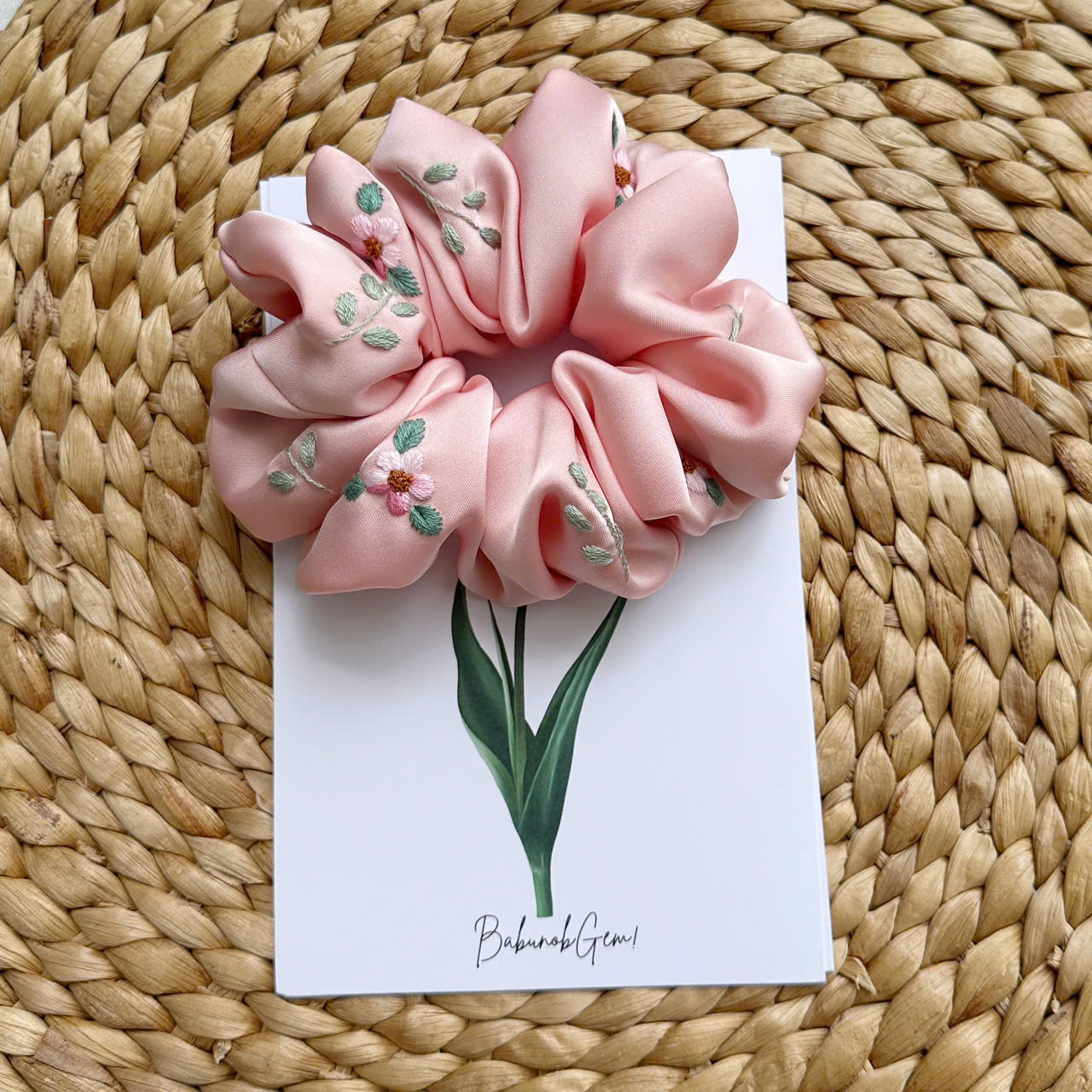
If heavy hair ties weigh down your thin hair or slide loose, a different style may be worth a try. Our Wildflower Silk Scrunchie is hand-embroidered with wildflowers in small batches and comes in 6 colors.
How to Style Thin Hair with a Scrunchie Step by Step
To style thin hair with a scrunchie, add a little dry texture, anchor the hair with a subtle base, and loop the scrunchie only two or three times.
Fine hair benefits from a simple routine. Standard rubber elastics can cut into delicate strands, while heavy claw clips may tilt backward on low-density hair. At BabunobGem, our studio makes hand-embroidered accessories, mainly on natural linen. Whether you prefer a wildflower silk scrunchie, a linen bow scrunchie or embroidered button hair ties, following a clear sequence makes it easier to get a steady hold and some volume. Once you master the basics, you can learn the beaver tail braid for a decorative twist on the ponytail.
Step 1: Prep Hair Texture Without Heavy Residue
Fine hair easily flattens under heavy leave-in conditioners, heavy silicones, or thick styling creams. Begin styling on dry, clean hair that has been washed with a gentle volumizing or clarifying shampoo. If your hair is naturally smooth or freshly washed, it may lack the grit needed to grip fabric fibers.
Mist a lightweight dry texturizing spray or sea salt mist through your mid-lengths and ends. Avoid spraying texturizers heavily at the roots to prevent stiffness. Lightly scrunch the hair with your hands to create natural micro-waves. This adds a little strand-to-strand friction, giving your scrunchie something to hold onto.
Step 2: Build an Internal Base Anchor
If your hair is ultra-fine or silky, wearing a fabric accessory alone may cause gradual slippage as you walk or move. A small hidden anchor can support the updo so you do not need to wrap your scrunchie tightly.
Gather your hair at your desired height and secure it first with a tiny, clear snagless elastic band. Alternatively, insert two bobby pins crossed in an X shape directly at the base of your gathering. Once this subtle core is established, slide your scrunchie directly over the anchor. The small elastic holds the weight of your hair, and the scrunchie sits over it as a decorative cover.
Step 3: Secure a Voluminous Low Ponytail
A low ponytail at the nape of the neck is an easy everyday style for thin hair, and it usually pulls less than a high one. Gather your hair loosely just above the collarbone. Slide your scrunchie over the strand bundle and loop it twice. For fine hair, two loops are a good starting point; stop there if the hold already feels snug.
After securing the band, place your fingers at the crown and gently pull small sections upward by a few millimeters. This pancaking technique introduces soft height at the back of the head. Next, divide the ponytail into two halves underneath and give a gentle outward tug. This can help the scrunchie sit closer to the head without adding extra loops. Scrunchies also finish braids nicely, and our scrunchie for braids guide shows how.
Step 4: Craft a Soft Cloud Bun
High, rigid buns can pull delicate baby hairs along the hairline and expose areas of low scalp density. A relaxed cloud bun placed at mid-height can make hair look fuller. Start by gathering your hair into a mid-level ponytail base. For a playful throwback, try these 90s hairstyles with scrunchies and a soft updo.
Twist the lengths loosely into a soft spiral, coiling it around the base like a cinnamon roll. Slip your scrunchie over the bun twice. Instead of winding the hair tightly, allow the outer loops of the bun to puff outward. Gently tug the outer edges of the twist to expand the bun’s visual footprint. If necessary, tuck two U-shaped hairpins into the perimeter to stabilize the shape without compressing the soft texture. Soft buns come together quickly with a hair tie for a messy bun, as this tutorial shows.
Step 5: Secure a Romantic Half-Up Crown
A half-up hairstyle is practical for low density hair because it preserves strand fullness through the lower lengths while keeping front layers away from the eyes. Part your hair naturally, then use your fingers to section away the top third from temple to crown. For a relaxed half-up feel, try this ponytail and hair down style.
Twist the two side sections lightly toward the center back of your head. Secure them together with a small silk or linen scrunchie, looping it twice. Leave a few soft face-framing tendrils loose around your ears and temples. The half-up arrangement leaves the lower lengths full and shows the embroidery against your natural hair color. For a playful twist, this guide to hair ties for space buns shows how to start.
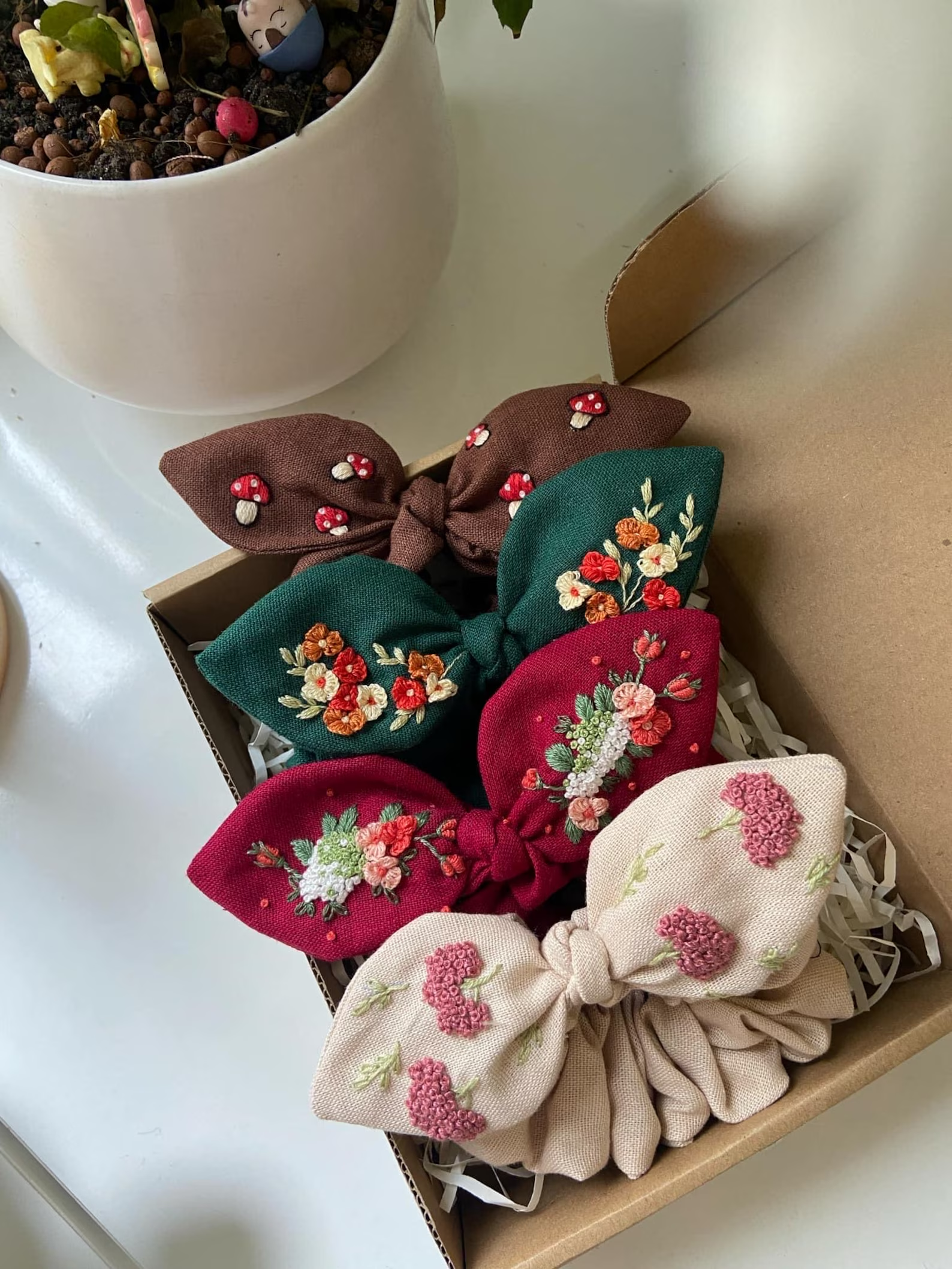
Building a small collection of hair accessories? US shipping is $7 for the first item and $1 for each extra item, so you can pair this Linen Bow Scrunchie with a few other pieces.
Studio Experience: Practical Tips for Fine Strands
A few small habits help: turn the embroidery to the top of your bun or ponytail, add a hidden pin or elastic for support, and spot clean gently.
In our studio in Ho Chi Minh City, we spend our days working with embroidery thread, linen and hair accessories of all kinds. Here are four practical techniques we share with women styling fine or thin hair.
Turn the Embroidery to the Top: In our studio, we stitch wildflower motifs by hand. When you wear an embroidered scrunchie with thin hair, rotate the piece so the hand-stitched floral motif sits on the top or upper curve of your bun or ponytail, where it is easiest to see.
Use the Invisible Hairpin Lock: If you prefer wearing your scrunchie without a hidden elastic base, use two matte bobby pins as anchors. Slide one pin diagonally upward through the bottom fabric fold of the scrunchie directly into your hair, and cross a second pin over it in an X shape. This can help anchor the fabric without squeezing the hair bundle.
Spot Clean Gently: Hair oils and styling products can leave marks on fabric over time. We do not recommend putting hand-embroidered scrunchies in a washing machine or soaking them. Instead, spot clean with a clean, damp cloth and cool water, then lay the accessory flat to air dry away from direct sunlight.
Pair with Snap Clips or a Headband: When styling fine hair, putting all the volume at the back can make the crown look flat. We often suggest pairing a scrunchie with our set of embroidered linen-wrapped snap clips (each about 7 cm) or a 1.2 in (3 cm) linen headband on a soft, stretchy band. They frame your hairline and help keep shorter flyaways back.
Common Styling Mistakes and How to Avoid Them
Common mistakes when using a scrunchie with thin hair include wrapping bands too tightly, choosing excessively heavy textiles, and sliding accessories out over tangled strands.
Fine strands can be more fragile than coarse ones, so daily friction and hard pulling can lead to breakage and split ends.
Mistake: Over-Tightening to Prevent Slippage. Wrapping a scrunchie four or more times to force a tight grip keeps your hair under constant tension. The American Academy of Dermatology notes that hair pulled back tightly over and over can cause traction alopecia, a type of hair loss. If your scrunchie feels loose after two wraps, do not force an extra loop; instead, spray dry texture mist onto your strands or use a small base anchor beneath the fabric. If you notice thinning, see a dermatologist. If your hair is curly, our guide to hair ties for curls covers options worth knowing.
Mistake: Choosing Heavy, Bulky Fabrics. Chunky velvet, faux fur, or oversized polyester ruffles add unnecessary gravitational weight to thin hair. The weight can pull the ponytail downward and flatten root volume. The fix is to choose lightweight textiles such as silk, linen or light cotton, which usually add decorative texture with less drag on fine strands.
Mistake: Pulling the Scrunchie Out Horizontally. Ripping or dragging a scrunchie straight off a ponytail can cause friction and snap fragile hairs, especially if strands are tangled around the band. The fix is simple: gently unloop the scrunchie layer by layer with both hands. If you ever get scalp soreness or headaches from styling, take the accessory off, and see a doctor if it continues.
Each piece is embroidered by hand in our Ho Chi Minh City studio, so each one is slightly different. Orders are usually prepared in 1 to 3 business days and take an estimated 10 to 14 business days to reach the US, with tracking. You can return items within 30 days under our Return Policy.
Scrunchie Thin Hair FAQ
Does a scrunchie cause less damage to thin hair than a standard elastic tie?
Often, yes, but it depends on how you wear it. A scrunchie is usually an elastic band covered in gathered fabric, so it is wider than a thin elastic and may spread the pull over a larger area. A thin elastic concentrates pressure on a narrow strip of hair and can leave dents or snap fragile strands. Any tie can still pull if you wrap it tightly, so keep the loops loose.
How many times should you loop a scrunchie on fine hair?
Two loops are a good starting point for most fine hair. For a small half-up section, a third loop may work if it does not pull on your scalp. If two loops feel slightly loose, do not force a tight third loop. Instead, prep strands with dry texture mist or use a tiny snagless elastic anchor beneath the scrunchie.
Which fabric works well for a thin hair scrunchie?
Lightweight fabrics such as silk, linen and fine cotton are good places to start for fine and thin hair. Silk has a smooth surface with little friction, which can mean less snagging but also less grip. Linen has a natural, slightly textured weave that can give a bit more grip on smooth hair. Both are lighter than velvet or dense polyester, which can drag on fine hair.
Can wearing a scrunchie help thin hair look fuller?
Yes, styling with a scrunchie can create the visual impression of thicker hair. The gathered fabric ring adds physical circumference around the base of your ponytail or bun, making the gathered hair look more substantial. Techniques like gently loosening crown strands or pancaking the outer edges of a low bun expand the updo’s profile, giving fine hair airy dimension.
How do you stop a silk scrunchie from sliding down fine hair?
To help a smooth silk scrunchie stay put on slippery hair, begin by applying a light mist of dry texturizing spray through your mid-lengths. Next, secure your ponytail with a tiny clear elastic band or two crossed bobby pins first. Slide the silk scrunchie directly over this base. The hidden anchor supports the style while the scrunchie covers it.
Mindful Styling with BabunobGem
Styling thin hair starts with a lightweight fabric, a loose wrap and a little prep. At BabunobGem, we make hand-embroidered accessories in small batches in our Ho Chi Minh City studio, mainly on natural linen. Most items are under $25. US shipping is $7 for the first item and $1 for each extra item, and you can return items within 30 days under our Return Policy.
New here? Get 10% off your first order
Join our list for new small-batch designs and restocks, or browse the collection now.
Note: Each piece is embroidered by hand, so stitches and colors can vary slightly from the photos. Fit and feel depend on head size, hair type and how you wear it. This guide is for general information only.