Types of Claw Clips for Every Hair
Types of claw clips vary in size, shape, tooth spacing and material, and each one holds hair a little differently. This guide from BabunobGem explains the main styles, where claw clips came from, and how to match a clip to fine, thick or curly hair and the way you like to wear it.
Key highlights
- Explore standard, flat, open-frame, and fabric-wrapped claw clips tailored to distinct hair textures and volumes.
- Learn where claw clips came from and how the spring and teeth hold your hair.
- Follow a practical four-step method to select tooth geometry, cavity volume, and material for full or half-up styles.
- Avoid common placement errors and root tension that can strain your hair.
Understanding Claw Clip Types and Materials
Different types of claw clips differ in tooth shape, jaw size and body material, from molded plastic and acetate to embroidered fabric. Matching these to your hair density helps a clip hold without tugging at your strands.
Claw clips are a staple of everyday styling because they hold hair with interlocking teeth instead of a tight elastic. A hair tie wraps around a ponytail and presses on one ring of hair, which can crimp or snap fragile strands over time. A claw clip, in contrast, cradles the bundle between two rows of curved teeth against the curve of your head.
Not all clips work the same way. A small clip meant for a partial updo can buckle if forced over dense curls, while a heavy rectangular clip may slide down fine, straight hair. Tooth spacing, jaw size and weight explain much of the difference.
The Origin: When Were Claw Clips Invented and Who Invented Them
Many hair lovers wonder when were claw clips invented and who invented claw clips before they became universal fashion accessories. The modern hair claw is usually credited to a French inventor, Christian Potut, in the late 1980s. The idea was to join two curved combs with a metal spring so the clip closes on its own, with no pins or rubber bands needed. Accounts of its origin vary, so treat the details as approximate.
The clip became hugely popular in the 1990s and has made a comeback in recent years. While early models were mostly plain plastic, today’s designs include many shapes, artisan textiles and specialized silhouettes.
Anatomy Breakdown: Types of Claw Clips Names and Tooth Geometries
Familiarizing yourself with types of claw clips names makes shopping much simpler. Traditional curved jaws feature rounded teeth that overlap closely, forming a semi-circular cavity designed to hold a standard vertical twist. In contrast, flat claw clips (often called back-laying clips) position their hinge mechanism parallel to the head, keeping the teeth spread wide and flat so they can be more comfortable to lean back against on a high-backed chair or car headrest. For more shapes and looks, see our overview of hair claw clip styles.
Rectangular box clips provide a structured, geometric appearance with wide-set teeth and a broad internal chamber, which can make them a good fit for gathering coarse hair. Open-frame clips, sometimes known as cage clips or window clips, eliminate the solid outer shell in favor of negative space, reducing total clip weight while letting the natural hair color peek through. Small butterfly clips feature short prongs and miniature springs, designed primarily for sectioning accent braids or pinning back wispy bangs. Other accessories have their own labels too, as our list of hair clip names shows.
Material Basics: Molded Plastic, Acetate, Metal and Fabric
The base material affects how a clip feels against your hair and scalp. Mass-produced claw clips are often molded from plastics such as ABS. While lightweight and inexpensive, brittle plastic teeth can snap when stressed by thick hair, and rough seam lines left by factory molds can snag hair during insertion and removal. Cellulose acetate, which is made from wood pulp and cotton fibers, is often polished smooth and tends to have fewer rough edges.
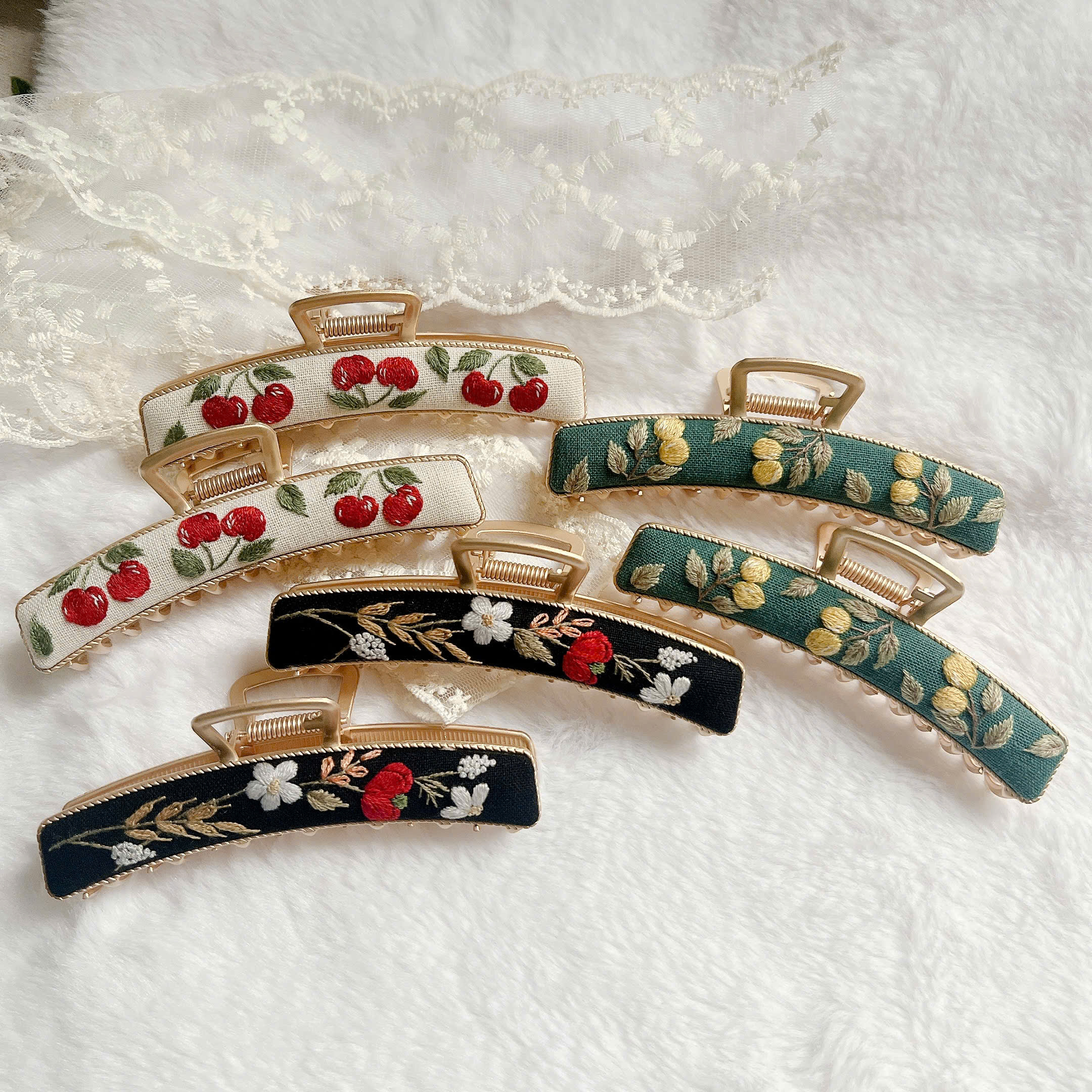
Metal claw clips, often made from zinc alloy or bent wire, tend to be sturdy with strong spring tension. However, their heavier weight can drag down fine or silky hair. Fabric-covered clips are another option. In our studio, we make hand-embroidered claw clips for half-up styles and fine hair. You can browse our full range of hand-embroidered claw clips here whenever you are ready.
| Clip Silhouette | Structural Mechanism | Cavity & Grip Characteristics | Recommended Hair Type |
|---|---|---|---|
| Classic Curved Jaw | Opposing curved teeth with central spring | Medium cylindrical cavity, overlapping teeth | Medium density, straight to wavy textures |
| Flat Back-Laying Clip | Horizontal hinge with wide, low-profile teeth | Shallow chamber, rests flat against the skull | Fine to medium hair, commuters, desk work |
| Rectangular Box Claw | Straight-edged frame with deep perpendicular teeth | Spacious rectangular cavity, wide-spaced teeth | Thick hair, long locks, coarse waves |
| Open-Frame Window Clip | Hollow wire or cutout acetate shell | Lightweight body, medium cavity volume | Fine to medium hair wanting minimal weight |
| Petite Butterfly Clip | Miniature spring with short interlocking prongs | Minimal volume capacity, high localized grip | Fine sections, accent braids, bangs |
| Long Slender Barrette Claw | Extended horizontal bar with shallow teeth | Long narrow hold, low volume capacity | Half-up styles, fine strands, soft twists |
| Embroidered Claw Clip | Interlocking teeth with a spring, like any claw clip | Hand-embroidered floral design | Half-up styles and fine hair |
| Jumbo Deep-Barrel Claw | Oversized heavy-duty spring with extended teeth | Maximum interior cavity, wide spread | Very thick hair, natural curls, dense coils |
| Double-Row Grip Claw | Dual rows of teeth on each opposing wing | Double interlocking perimeter for extra grip points | Silky, straight hair prone to sliding out |
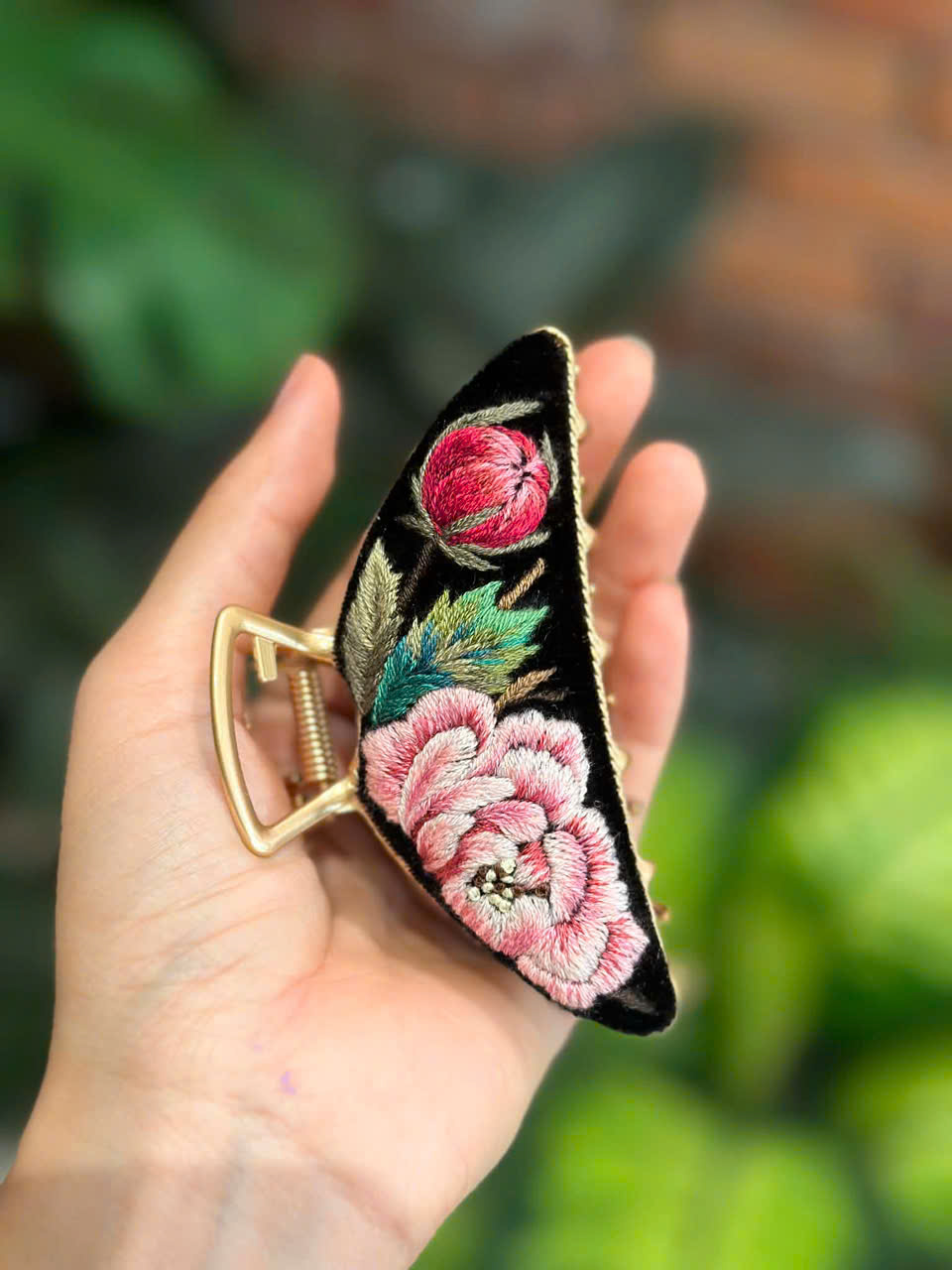
If slick plastic clips tend to slide out of your fine hair, a different style may be worth trying. Our Embroidered Claw Clip has hand-embroidered floral stitching and suits half-up styles and fine hair.
How to Choose the Right Claw Clip Step by Step
Choosing the right claw clip comes down to four checks: your hair volume, the clip’s jaw size, its material, and the hairstyle you want. Going through them in order can reduce slipping and hair strain.
A frequent cause of clip frustration is a mismatch in size. Many people buy an attractive clip online, then find it pops open or slides down toward the nape of the neck. Often the issue is not your hair texture but the match between the amount of hair and the clip’s jaw size. Checking your hair first makes it easier to pick a clip that fits.
Step 1: Assess Your Hair Density and Strand Caliber
Begin by distinguishing between your hair density (the total number of individual strands on your head) and strand caliber (the thickness of each individual strand). A simple way to judge overall volume is to gather your hair into a ponytail and see how full it feels in your hand: a slim ponytail points to fine or lower-density hair, an average one to medium volume, and a very full one to thick or high-density hair.
Strand texture also influences how a clip grips. Silky, fine strands have little surface friction and can slip through wide-spaced teeth, so closely spaced teeth with overlapping tips tend to hold better. In contrast, coarse or curly strands create natural friction against each other, so clips with generous tooth spacing and a sturdy build are usually a better match and less likely to pinch or snag individual curls.
Step 2: Match Tooth Spacing and Barrel Volume
Once you know your volume, evaluate the internal cavity of the claw clip. The barrel refers to the hollow open space created when the opposing jaws are closed. If you have thick, shoulder-length or longer hair, you usually need a deep-barrel clip with long, widely spaced teeth. Forcing a thick twist into a shallow clip stresses the central spring and can eventually cause the plastic hinge to snap.
For fine hair or shorter bobs, a large barrel leaves excess empty space. Without hair volume to push back against the teeth, the spring may not generate enough tension to hold the clip in place, and it can slide downward. For these hair profiles, choose compact clips with shallow barrels and closely interlocking teeth, which are made for smaller amounts of hair.
Step 3: Select the Base Shell and Exterior Texture
Evaluate your daily environment and styling preferences when choosing between sleek acetate, solid metal, or fabric-covered designs. High-gloss acetate and smooth metals give a clean, modern look, but they offer little surface friction. If your hair is straight, freshly washed or naturally slippery, these smooth surfaces can let strands glide out of the clasp.
If you like an artisan look, textured fabrics are another option and may add a little grip. As one choice among many styles, our hand-embroidered claw clips suit half-up styles and fine hair. When selecting accessories, you can balance smooth finishes for quick updos with textured ones for a handmade look. If you like textured fabrics, you can see our handmade hair clips in the shop.
Step 4: Align the Clip Profile with Your Target Hairstyle
Decide whether you intend to wear full updos, messy buns, or half-up arrangements before committing to a clip silhouette. A full French twist gathers all hair vertically along the crown, which usually calls for an elongated rectangular or curved claw with enough tooth length to anchor into the base hair. If the teeth are too short, they may only grab the outer twist and leave the style feeling unstable.
If your goal is a romantic half-up look, a full-size twist clip can feel too heavy and tilt backward. For half-up styling, try a slender barrette claw, one of our hand-embroidered claw clips (they suit half-up styles) or a petite open-frame design. These lighter shapes gather just the crown and temple sections. For more half-up inspiration, these barrette hairstyles show other ways to pin hair back.
Pairing a few hair accessories? US shipping is $7 for the first item and $1 for each extra item.
Studio Tips for Wearing and Styling Claw Clips
A few simple habits help: anchor the clip in a loose twist, tilt the hinge so it does not press into a headrest, and keep the spring clean. These are techniques we often share in our studio.
In our studio, we spend our days stitching and working with hair accessories of all shapes. Here are four practical tips we often share with women who wear claw clips.
The Base Twist Anchor for Slippery Strands If your hair tends to slide out of claw clips, avoid clamping loose hair directly. Instead, gather your desired section, give it two full turns at the base, and then fold the twisted stem upward against your head. Insert the lower teeth of the claw clip underneath this twisted core before closing the jaws. The twist acts as an anchor and can help the teeth stay put on slick strands.
Angling the Hinge for Commuters and Desk Workers Traditional barrel claw clips can press uncomfortably into the skull when leaning against a high-back office chair or car headrest. To lower the chance of this, tilt your clip on a slight diagonal rather than clipping it completely vertical. Alternatively, try a flat back-laying clip, which sits flatter against the back of your head.
Spot Cleaning Embroidered Clips Hand-embroidered accessories need gentle care. We do not recommend soaking them or putting them in a washing machine. If your clip gathers dust or makeup smudges, spot clean it gently with a soft cloth lightly dampened with cool water, then let it air dry fully in a shaded area.
Layering Embroidered Clips with Headbands For days when wispy baby hairs escape around your hairline, pair a half-up claw clip with a headband. In our studio, we like to style hand-embroidered claw clips alongside our hand-embroidered linen headbands, which are 1.2 in (3 cm) wide and sit on a soft, stretchy band. The headband keeps front flyaways back while the claw clip gathers the crown section, for a balanced cottagecore look. For pinning small sections, you can see our embroidered snap clips here.
Common Claw Clip Mistakes and How to Avoid Them
Common claw clip mistakes include forcing excessive hair volume into small hinges, clamping damp hair with aggressive tension, and pulling roots too tight against the scalp. Correcting these habits can help reduce breakage and tension along the hairline.
Claw clips can be gentler than a tight elastic, but using them incorrectly can still lead to strand breakage, split ends or scalp tenderness. Paying attention to how you place your clip helps reduce the strain on your hair. To learn how to wear them gently, read our answer to are claw clips bad for your hair.
Mistake: Forcing High-Density Hair into an Undersized Shell Gathering thick or long hair into a clip designed for half-up styling puts extra outward pressure on the spring. This can bend the teeth outward, crack plastic hinges or make the clip pop off during movement. If you feel resistance when closing the jaws, release a portion of the hair and re-clip only the top half, or upgrade to a deep-barrel jumbo design that accommodates your full hair density. For fuller hair, you can see our embroidered large claw clip here.
Mistake: Pulling Hair Roots Too Taut Before Clamping Many people pull their hair back with excessive tension, hoping to achieve a sleek, tight look before fastening the claw. However, constant tension can leave your scalp sore. The American Academy of Dermatology notes that hair pulled back tightly over and over can cause traction alopecia, a type of hair loss. When gathering hair, leave some slack along the temples and crown. If you feel tightness or get a headache, take the clip out, and see a doctor if it continues.
Mistake: Tossing Hair Clips Loose into Heavy Handbags Tossing claw clips loose into a tote bag exposes them to heavy items like water bottles, books and keys. Knocks can snap plastic teeth or snag embroidered stitching. To protect your clips, keep them in a small pouch or clip them onto the inner strap of your bag when not in use.
Each piece is embroidered by hand in small batches, so each one is slightly different. Orders are usually prepared in 1 to 3 business days and take an estimated 10 to 14 business days to reach the US, with tracking. You can return items within 30 days under our Return Policy.
Types of Claw Clips FAQ
When were claw clips invented and who invented claw clips?
The modern claw clip is usually credited to a French inventor, Christian Potut, in the late 1980s. He joined two curved combs with a metal spring so the clip closes on its own. It became hugely popular in the 1990s and has made a comeback in recent years. Accounts of its origin vary, so treat the details as approximate.
What are the primary types of claw clips names used in hair styling?
The most common types of claw clips names include classic curved jaws, flat or back-laying claws, rectangular box clips, open-frame window clips, petite butterfly clips, long barrette claws, and embroidered claws. Each name reflects the silhouette of the outer shell and the configuration of the teeth, which affect whether the clip suits full updos, partial twists or small accent sections.
Which types of claw clips are most suitable for fine or thin hair?
For fine or lower-density hair, compact clips with closely spaced, interlocking teeth usually work well. Large jumbo clips leave extra space inside, which lets fine strands slip through. Slender barrette claws and flat back-laying clips are also worth a look, because their lighter weight may mean less pull on your roots. Our hand-embroidered claw clips suit half-up styles and fine hair.
Can wearing a claw clip cause headaches or hair damage?
It can, if it is worn too tight or if the teeth press into your scalp. As noted above, hair pulled back tightly over and over can cause traction alopecia, a type of hair loss. To lower the risk, avoid pulling hair taut before clamping, angle the clip along the curve of your head, and take it out if you feel tenderness, pressure or a headache. If it continues, see a doctor.
How do you clean a hand-embroidered claw clip?
Hand-embroidered claw clips should be spot cleaned only. Do not soak the clip in water, scrub the stitches harshly, or put the piece in a washing machine. Dampen a clean, soft cloth with cool water, gently dab away smudges on the fabric, and let the clip air dry naturally away from direct sunlight and heat.
Finding Your Everyday Claw Clip with BabunobGem
Choosing the right claw clip is easier once you know how size, teeth and material affect the way a clip holds. At BabunobGem, we hand-embroider hair accessories in small batches in our Ho Chi Minh City studio. Most items are under $25. Orders are usually prepared in 1 to 3 business days and take an estimated 10 to 14 business days to reach the US, with tracking.
New here? Get 10% off your first order
Join our list for new small-batch designs and restocks, or browse the collection now.
Note: Each piece is embroidered by hand, so stitches and colors can vary slightly from the photos. Fit and feel depend on head size, hair type and how you wear it. This guide is for general information only.