Cute Hairstyles for School & Students
Hairstyles for school should be quick to do in the morning and comfortable to wear through classes, study halls and walks across campus. This guide from BabunobGem covers easy step-by-step styles, simple accessory tips and common mistakes for students who want neat, natural hair on busy school mornings.
Key highlights
- Explore quick, functional hairstyles tailored for long classroom days, active PE periods, and intense study sessions.
- Follow a simple five-step morning routine for neat, practical school styles.
- Compare popular school hairstyles by rough prep time, hair texture and suggested accessories.
- Studio tips for dealing with backpack strap friction and pressure behind the ears.
- Common styling mistakes, including why tight, everyday ponytails are worth avoiding.
What Makes a Great School Hairstyle: Core Factors and Daily Needs
A practical school hairstyle takes little morning effort, keeps strands out of your face while you study, and avoids excessive scalp tension. The right mix of texture prep, thoughtful placement and accessories can help hair stay neat from first period through after-school activities.
School mornings rarely afford half an hour of dedicated mirror time. Between early alarms, rushed breakfasts, and commuting to campus, styling routines must remain realistic. A style that falls apart by second period is a distraction, so it helps to choose arrangements that can handle locker visits, brisk walks between buildings and hours bent over notebooks or laptops. Since the school year starts in autumn, our fall hairstyle ideas pair well with sweaters and scarves.
When planning cute hairstyles for back to school, consider how your hair interacts with your environment. Humidity in crowded classrooms, dry heating in winter and PE classes all test a style’s hold, so pick a look you will not need to fix in the restroom mirror between classes.
Desk Ergonomics, Textbooks, and Face-Framing Strands
The primary function of any school hairstyle is keeping hair away from your face while reading, writing, and testing. When stray locks tumble across your forehead or brush your eyelashes, you instinctively push them away. Doing that again and again during an exam can leave oil, graphite and ink from your fingers on your hair, which can make the front sections look limp by lunchtime.
Practical styling focuses on securing the crown and the sides near your temples while leaving the rest of your hair free or loosely gathered. Half-up twists, pinned side bangs and wide fabric bands can keep your view clear without forcing all your hair into a severe updo.
Backpack Straps, Hoodies, and Nape Friction
Students regularly carry heavy backpacks loaded with textbooks, laptops, and water bottles. Backpack straps rub against your shoulders, upper back and the nape of your neck. If you wear your hair down or in a low ponytail secured with a bulky clip, the straps can rub against your hair, causing tangles and, over time, breakage.
Think about where your hair sits relative to your clothing. Bulky winter hoodies and coat collars bunch up around the collarbone and can push low updos out of place. Placing buns slightly higher on the crown, or wearing smooth three-strand braids, can keep your hair from getting trapped under the straps when you swing your backpack on between classes.
Time Budgets for Morning School Routines
When planning back to school hairstyles, sort your ideas into quick, medium and longer styling tiers. Save intricate braids for mornings when you wake up ahead of schedule, and rely on dependable quick routines for days when you hit the snooze button twice. Many of these quick routines carry over to the office, as our guide to cute hairstyles for work shows.
Working with your natural hair texture rather than fighting it is a good way to save time. Natural waves, loose curls and day-two volume can all be shaped quickly with small accessories instead of heat tools. Linen-wrapped snap clips, embroidered claw clips and fabric headbands can add a visual detail to an ordinary low bun for a cottagecore look. For dressier weekends, you can borrow ideas from these shoulder length wedding guest hairstyles.
School Hairstyle Formats at a Glance
The table below compares popular hairstyles for school by rough prep time, hair length and texture, and a suggested accessory. Times are estimates and will vary with your hair and practice.
| Hairstyle Option | Rough Prep Time | Hair Length & Texture | Suggested Accessory |
|---|---|---|---|
| Half-Up Crown Twist | 2–3 minutes | Medium to long; straight, wavy, or curly | Embroidered claw clip |
| Low Bubble Ponytail | 4–5 minutes | Shoulder-length or long; medium to thick | Soft fabric hair ties |
| Classic French Braid | 5–7 minutes | Long; many hair textures | Wildflower-embroidered scrunchie |
| Linen Headband Tuck | 1–2 minutes | Bobs to long hair | 1.2 in natural linen headband |
| Claw Clip Nape Twist | 1–2 minutes | Fine hair; shoulder-length | Embroidered claw clip |
| Low Textured Messy Bun | 3–4 minutes | Medium to long; wavy or textured | Linen scrunchie with bow |
| Pinned Side Dutch Braid | 5–6 minutes | Long; straight to thick waves | Linen snap clips (7 cm) |
| Twin Low Pigtail Braids | 4–5 minutes | Shoulder-length to long; many textures | Button hair ties set |
| Relaxed Top Knot | 2–3 minutes | Medium to long; curly or textured | Soft botanical scrunchie |
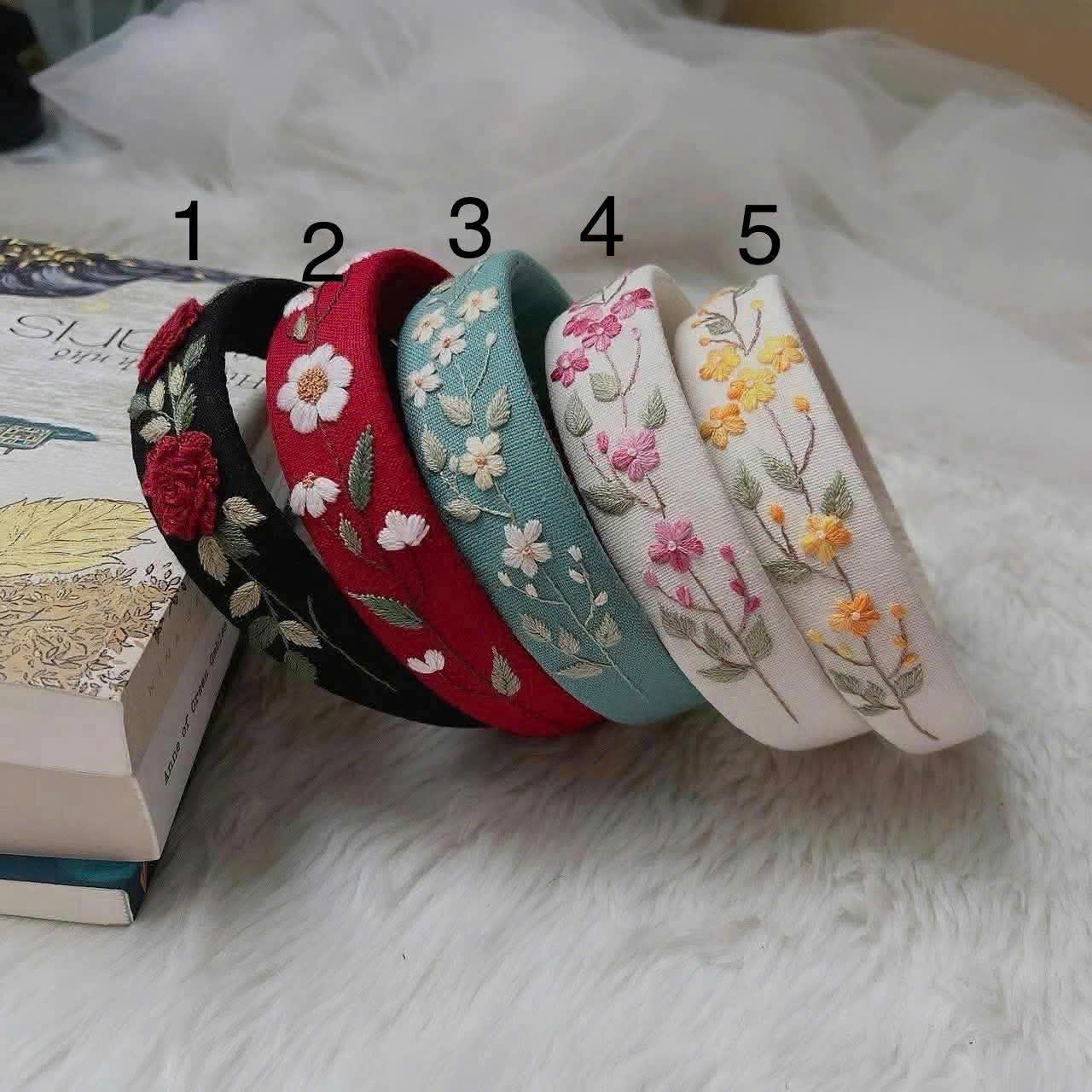
Wildflowers Embroidered Headband
If hard plastic hairbands press behind your ears during morning lectures, a fabric band without a rigid frame may be worth trying. This 1.2 in (3 cm) wide band is hand-embroidered with wildflowers on natural linen and sits on a soft, stretchy band.
How to Create Easy Back to School Hairstyles: Step-by-Step Guide
Creating cute hairstyles for back to school starts with your natural hair texture, balanced sections and low-tension fasteners. The five steps below take you from prep to finishing touches.
When students try easy back to school hairstyles without a consistent method, the style often slips out of place before lunch. Many reach for strong hairspray or pull elastics so tight that their scalp aches by noon. A balanced approach uses a light hold, good anchoring and a loose grip at the roots.
Rigid plastic clips and exposed metal bobby pins can snag fine strands or dig into the scalp when you rest your head against the back of a desk chair, so fabric-covered options such as scrunchies and headbands are worth a look. Below is a five-step method you can adapt for a half-up twist, a low braided bun or a quick textured ponytail. For gym class, our guide to workout hairstyles covers styles built for movement.
Step 1: Prep Hair Texture and Assess Daily Campus Movement
Begin by working with your hair as it is rather than starting an extensive restyling process from scratch. Day-two hair often gives braids and clips more to grip than freshly washed hair. If roots feel flat, gently brush through with a wide-tooth comb or dust a little dry shampoo along the crown to absorb excess oil.
Take a moment to think through your schedule. If you have PE or an art class with paint and pottery wheels, plan a fully contained style such as double braids or a high bun. If you will spend hours in an air-conditioned lecture room, a half-up style with an embroidered claw clip can keep hair out of your face while the rest falls over your neck. If you have plans after class, these cute date hairstyles can start from the same half-up base.
Step 2: Establish a Clean Parting and Section the Crown
Using your index fingers or the tail of a comb, trace a clean parting. A center part gives braided pigtails and low buns a balanced look, while a soft off-center part adds a romantic, cottagecore touch to casual half-up styles. A clean parting can make even a simple hairstyle look polished and intentional.
Isolate the upper section of your hair by tracing a line from the top of your ears backward to the crown. Smooth this top section with your fingers rather than a stiff brush to keep natural volume. Holding it steady prepares your foundation for clips, barrettes or twists without disturbing the lower layers.
Step 3: Build the Foundation with Gentle Low-Tension Techniques
With your crown section separated, gather the hair into your desired foundation. If you are crafting a half-up style, gently twist the gathered strands two or three times to form a compact rope. If you are creating a low bun or braid, gather all strands near the nape of the neck, keeping the grip relaxed so you do not pull tightly on your temples.
Avoid pulling the hair taut against your scalp. Tight tension does not mean a longer-lasting hold; it can make your scalp sore and make you want to take your hair down midway through the school day. A little slack along the hairline gives you room to turn your head to read the whiteboard or talk with classmates.
Step 4: Anchor with Balanced, Friction-Friendly Accessories
Secure your style with an accessory that suits your hair density. For a half-up style on fine hair, position an embroidered claw clip over the twisted section and release the spring so the teeth grip the twist. For a neat half-up section, an oval linen-wrapped barrette (about 3.5 × 1.5 in) with an embroidered rosette is another option.
If you prefer wearing your hair down, slip a hand-embroidered linen headband, 1.2 in (3 cm) wide with a soft, stretchy band, over your crown, about an inch behind your hairline. For braids, fasten the ends with an embroidered scrunchie or an embroidered button hair tie.
Step 5: Detail, Loosen Strands, and Check Nape Clearance
Once your primary accessory is anchored, take a moment to refine the details. Gently pull a few soft tendrils loose around your temples and sideburns to soften your facial profile. If you created a braid, lightly pancake the outer loops by gently tugging them outward with your fingertips; this simple step can make a three-strand braid look thicker and more relaxed. The same finishing touches work for special nights too, as our cute hairstyles for prom guide shows.
Finally, check your neck movement and backpack clearance. Tilt your head from side to side and roll your shoulders back. If you feel a sharp pinch or pulling, loosen the accessory slightly and re-clamp it. A quick check like this before you leave the house can save you from readjusting your hair all day.
Studio Styling Tips for Students and Busy Mornings
Practical school styling starts with placing accessories where they will not press while you study. Small changes in how you angle clips and handle fabric bands can help your hair stay tidy through study halls, gym periods and commutes.
In our BabunobGem studio, we stitch each floral motif onto natural linen by hand, and we often tell people that where you place an accessory matters as much as which one you pick. Even a pretty piece can feel uncomfortable if it sits awkwardly against your head through a long school day. You can browse all of our embroidered hair accessories in one place.
Hair slipping out during midterms, hairbands pressing into temples during library research and hair ties snapping in gym lockers are common school-day frustrations. Here are four tips we often share.
Position claw clips higher on the crown when wearing heavy backpacks. When you carry a heavy bookbag, the padded straps and top handle ride high along your upper back and near the base of your skull. A claw clip fastened low at the nape can get bumped with every step, which can loosen its grip and press the teeth against your head. Try your claw clip mid-crown, or switch to a flat barrette when you carry a heavy load.
Use snap clips in an angled chevron to tame stray baby hairs. When you lean forward over an open textbook, fine baby hairs around your hairline tend to slip loose. Instead of dousing your bangs in sticky hairspray, slide two snap clips above each temple in an angled, crossing pattern. Our snap clips come as a set of 6, wrapped in embroidered linen, and each is about 7 cm long.
Match your accessory colors to everyday campus staples. A hand-embroidered accessory can add character to school outfits like oversized cardigans, denim jackets and neutral hoodies. In our studio, we like to pair a natural & cream band with green or rust knits. Floral motifs such as lavender, daisies or roses give a relaxed cottagecore feel. When a school dance comes up, these winter formal hairstyles help you dress the look up.
Keep a scrunchie on your wrist for quick classroom changes. When you move from a chilly, air-conditioned classroom to outdoor track practice or a science lab with open flames, you may need to tie your hair back quickly. A wildflower-embroidered scrunchie on your wrist lets you gather your hair into a topknot or low bun on the spot.
Common School Hairstyling Mistakes to Avoid
Common back to school styling errors include pulling hair into tight daily ponytails, wearing rigid accessories that dig into the temples, and styling damp hair before school. Changing these habits can help keep your scalp comfortable and your hair looking good.
When running late for the school bus, it is tempting to reach for quick fixes: pulling hair back as tightly as possible with rubber elastics or forcing wet hair into a tight bun. While these habits may seem convenient in the morning rush, tight styles can leave your scalp sore, and wet hair breaks more easily.
Here are three common styling mistakes, each with a simple adjustment.
Mistake: Pulling hair into tight high ponytails every single morning. Rushing out the door often leads students to pull their hair back into sleek, tight ponytails every day. The American Academy of Dermatology notes that hair pulled back tightly over and over can cause traction alopecia, a type of hair loss. Instead of tight daily ponytails, rotate your styles. Alternate between loose three-strand braids, half-up claw clip twists and loosely worn scrunchies. If your scalp feels tender or a style gives you a headache, take your hair accessories out, and see a doctor if it continues or a dermatologist if you notice thinning.
Mistake: Wearing rigid plastic headbands with inner teeth all day. Hard plastic alice bands with gripping teeth can press behind your ears, especially when you wear them for hours alongside eyeglasses or headphones. That pressure can leave your head sore by mid-afternoon. One option is a fabric headband on a soft, stretchy band, like our hand-embroidered linen headbands. If any band starts to hurt, take it off, and see a doctor if the soreness continues.
Mistake: Assembling updos or tight braids on soaking-wet hair before school. Jumping out of the shower and immediately plaiting wet strands or twisting them into a tight bun puts extra stress on your hair. Wet hair is weaker and more elastic, so tight elastics or rigid clasps can make strands stretch and snap as they dry. Tight wet buns can also trap moisture against your scalp for hours. Instead, towel-dry your roots, gently finger-detangle, and secure damp hair in a loose half-up style with an embroidered claw clip until it dries naturally.
Hairstyles for School FAQ
What are the easiest hairstyles for school when running late?
Two of the quickest options are the headband tuck and the half-up claw clip twist, and both usually go fast once you have practiced them. For the headband tuck, slip a 1.2 in wide fabric headband over your crown and tuck any wayward fringe behind your ears. For the claw clip twist, gather the top third of your hair, twist once, and secure it with a claw clip at the back of your head. Neither style needs heat tools or complex braiding.
How can I keep my hair out of my face during study sessions and exams?
To keep hair out of your eyes while you study, try a pair of 7 cm linen-wrapped snap clips or a fabric headband worn about an inch behind your hairline. Bulky clips placed low at the nape can bump against the high backs of study hall chairs, so wear them higher. Snap clips are a simple way to pin back bangs and wispy layers while you write.
Which hairstyles hold up well for physical education or sports class?
For high-movement activities like physical education, track or dance, twin Dutch braids or a low bun wrapped with a fabric scrunchie are popular choices because they keep hair close to your head. Braiding close to the scalp can help keep strands from tangling in the wind or whipping across your eyes when you run. If you prefer a sports headband, our embroidered sports headbands have a stretchy, one-size-fits-most band with botanical embroidery. Secure braid ends with soft elastic ties that have no exposed metal clasps.
How can I help hair accessories stay put in fine hair at school?
To help accessories stay put in fine, silky hair, add a little texture before styling. Lightly spritz dry shampoo or texturizing spray through your mid-lengths, or work with second-day hair rather than freshly washed strands. When using claw clips, choose smaller models for half-up sections, since oversized clips leave extra space that fine hair can slip through. Our hand-embroidered claw clips suit half-up styles and fine hair.
What are cute back to school hairstyles for short hair or bobs?
Short hair and bobs look charming with asymmetrical side clips or fabric headbands. You can create a simple waterfall twist by taking a small one-inch section of hair near your part, twisting it backward toward your ear, and securing it with an embroidered floral barrette or snap clip. A 1.2 in wide linen headband is another option for short cuts, since it can help keep front layers back when they are too short for a ponytail.
Finding Your Everyday School Rhythm
Good hairstyles for school are quick to do, comfortable to wear and easy to adjust, and they do not need elaborate morning routines. At BabunobGem, our small studio hand-embroiders accessories in small batches, mainly on natural linen. Orders are usually prepared in 1 to 3 business days and take an estimated 10 to 14 business days to reach the US, with tracking. You can return items within 30 days under our Return Policy.
New here? Get 10% off your first order
Join our list for new small-batch designs and restocks, or browse the collection now.
Note: Each piece is embroidered by hand, so stitches and colors can vary slightly from the photos. Fit and feel depend on head size, hair type and how you wear it. This guide is for general information only.